Behind the Trend: The Chemistry, Science, and Safety of Cysteamine-based products
The beauty industry moves at a breakneck pace, driven by social media trends and the rapid global expansion of Korean aesthetic techniques. Across North America, the "Korean Lash Lift" has surged in popularity, heavily promoted under sweeping marketing narratives that position these new systems as gentler, safer, and inherently healthier than traditional chemical lash lifts. Much of this narrative centres on replacing standard Thioglycolic Acid (TGA) with Cysteamine HCL, an ingredient routinely touted as a natural saviour for delicate lashes. However, behind these enticing sales pitches lies a complex chemical reality that many brands fail to disclose. Rather than dismissing Cysteamine outright, professional lash artists must understand the nuance of this chemical conversation. Cysteamine and TGA are simply different tools in an artist's kit; each with its own strengths, processing behaviours, and ideal client profiles. Empowering yourself with objective cosmetic science allows you to choose products that suit your skill level, your techniques, and your clients' unique natural lashes, while demanding transparency from the brands you trust.
The "Natural" Derivative Myth vs. Chemical Reality
At the heart of modern Korean lash lift marketing is the claim that Cysteamine-based products are inherently healthier because Cysteamine is a derivative of cysteine, an amino acid naturally present in human hair and eyelashes. While this chemical kinship is technically accurate, marketing teams often twist it into a narrative that Cysteamine works in a completely natural, non-damaging manner. In truth, both TGA and Cysteamine HCL are chemical reducing agents placed on fragile eye-area hair with one primary objective: breaking down disulphide bonds within the hair cortex so the lash can be reshaped.
The primary chemical distinction lies in how they target and break these bonds:
Thioglycolic Acid (TGA): Works with rapid, linear precision. It targets and breaks both delicate and strong disulphide bonds simultaneously right where it is applied. This creates a focused chemical reaction in a specific, controlled area (the apex line of the silicone shield).
Cysteamine HCL: Operates through a more delicate, dispersed mechanism. It first diffuses into the hair shaft to break down the softer, more delicate outer disulphide bonds before gradually penetrating to target the stronger, core structural bonds.
Because Cysteamine works on these delicate outer bonds first, marketers label it as fundamentally "gentler" or more "natural." However, just because an ingredient stems from an amino acid derivative and breaks bonds in a multi-stage fashion does not mean it operates without chemical stress. A slower bond-breaking process by no means removes the structural risks associated with chemical lash lamination, and assuming a Cysteamine formula is immune to causing lash damage is a dangerous misconception.
Watch our video on how TGA works to breakdown Disulphide Bonds
In in-dept explanation of how the chemical TGA works to break down disulphide bonds in eyelashes.
Watch our video on how Cysteamine-HCL works to breakdown Disulphide Bonds:
An in-depth explanation of how Cysteamine breaks down Disulphide bonds in eyelashes.
Regulatory Caps and the Fast-Processing Trap
Adding to the confusion is a widespread lack of cosmetic regulation surrounding active Cysteamine percentages. Traditional TGA-based formulas are subject to strict regulatory caps enforced by global governing bodies-including Health Canada and European cosmetic safety authorities-because TGA is a mature, extensively researched chemical with decades of published scientific literature. Cysteamine, on the other hand, lacks these standardized, enforced percentage limits across global cosmetic markets, as international safety databases historically contained very little literature regarding Cysteamine specifically intended for eyelash and eyebrow lamination. Because manufacturers rarely disclose exact chemical percentages on their bottles, the actual concentration of Cysteamine varies wildly from product to product. A Cysteamine-based system marketed to process rapidly in just a few minutes often achieves that speed through an extremely high concentration of raw Cysteamine. Consequently, an ultra-fast Cysteamine bottle can actually be significantly more aggressive on natural lash bonds than a balanced, legally capped TGA formula, completely contradicting the "gentler" label slapped onto the box.
Processing Speeds, Margin for Error, and Timing Precision
This reality directly challenges two major myths: first, that Cysteamine lamination is inherently faster than traditional systems, and second, that slower processing times automatically equate to a more controlled, safe treatment. In truth, a professional who masters a high-performance TGA system like InLei® Lash Filler 25.9 can complete the treatment in essentially the same amount of time as a Cysteamine service. Furthermore, many artists buy into Cysteamine systems believing a longer processing window offers a foolproof buffer against errors, but in practice, Cysteamine formulas leave remarkably little room for timing mistakes. Comparative testing reveals that when working with Cysteamine, a variation of just one single minute can mean the difference between a curl that holds for weeks and one that completely drops within fourteen days. When an artist blindly purchases an ultra-fast Cysteamine formula, they are pairing a high chemical concentration with an extraordinarily volatile timing window. Rather than offering increased control, fast Cysteamine systems strip away the artist's margin for error, making precise timing execution down to the second absolute paramount.
Raw Material Quality and the Problem of Curling Retention Drops
The volatility of Cysteamine treatments is further compounded by the drastic variations in the quality and stability of raw Cysteamine HCL raw materials. Unlike standardized TGA, raw Cysteamine purity and structural stability differ widely depending on raw material sourcing. When lash artists notice that a Cysteamine lift loses its shape after merely two weeks, it is rarely due to technician error; rather, it is a direct symptom of inadequate brand-level Research and Development (R&D) and unstandardized raw ingredient selection. When InLei® clinical laboratories first evaluated Cysteamine, early formulations presented significant hurdles with curl retention and unpredictable batch-to-batch strength. Without extensive, costly R&D to stabilize the raw chemical, many private-label brands market Cysteamine products that yield erratic results, leaving artists struggling with unexpected curl relaxation and inconsistent processing times from bottle to bottle.
Beyond the Box: Why Lash Artists Must Read the Hair
Because raw ingredient quality and chemical concentrations vary so drastically between brands, lash artists can no longer rely blindly on manufacturer-recommended processing windows or marketing claims. Relying strictly on a timer printed on a box is the fastest route to either severe under-processing or irreversible over-processing. Professional mastery requires artists to develop the technical skill to physically "read" the natural lashes throughout the service (using a technique called ‘Lash Check’), assessing bond breakdown in real-time rather than trusting an arbitrary window. This vigilance is particularly vital because Cysteamine requires a completely different physical application technique -known as the Korean method-where solutions are applied along the entire length of the hair shaft to achieve a full curl, unlike traditional TGA methods that target the apex of the lash.
Protecting the Delicate Lash Tips and Matching Client Lash Types
When applying chemical solutions root-to-tip, protecting natural lash integrity requires strict technical protocols and specialized target protection that any transparent brand with genuine integrity will advocate. Artists must maintain a clear safety buffer by staying at least one millimeter away from the waterline, and they must actively protect the delicate lash tips. Because the ends of natural eyelashes are significantly finer than the base and mid-shaft, leaving Cysteamine solution on the tips for the full duration of processing will cause kinking and severe over-processing. To solve this, advanced, well-researched formulations incorporate dedicated tip-protection lotions applied to safeguard the lash ends. Analytical data and microscopic comparative testing clearly show that utilizing a dedicated tip-protection product preserves the morphology and structural fiber integrity of the eyelash tip under chemical stress, keeping the hair significantly more intact. Moreover, artists must recognize that Cysteamine systems are not a universal fit for every client; on clients with coarse, resistant natural lashes, Cysteamine can take up to double the processing time of a standard TGA product to achieve a comparable curl.
Clinical Safety, Italian Batch Control, and Brand Accountability
Ultimately, Cysteamine-based systems are a welcome, innovative expansion in the lash lamination world when developed with care, research, and complete scientific honesty. True authority in the lash industry comes down to safety, rigorous quality control, and clinical validation. European cosmetic legislation is among the strictest globally, and Italian manufacturing standards demand rigorous quality checks for every single production batch - verifying microbiological purity, exact pH values, and formula stability before any product leaves the facility. If a batch fails even one quality parameter, it is discarded entirely. Because historical literature on Cysteamine in eye-area cosmetics was sparse, formulating a truly safe, high-performing Cysteamine line required generating extensive supporting data. To provide cosmetic safety assessors and artists with absolute confidence, InLei® conducted specialized clinical testing, including HRIPT (Human Repeat Insult Patch Testing, conducted in Canada) and rigorous ocular surface and peri-ocular area tolerance studies, officially certifying formulations like InLei® InForm 1, InStyle 2, and the full InLei® In-System as non-irritating and ophthalmologically tested. Navigating the modern lash industry doesn't mean rejecting new chemical innovations-it means holding brands accountable for their testing, understanding the technical nuances, and making informed choices that put lash health first.
Coming Soon
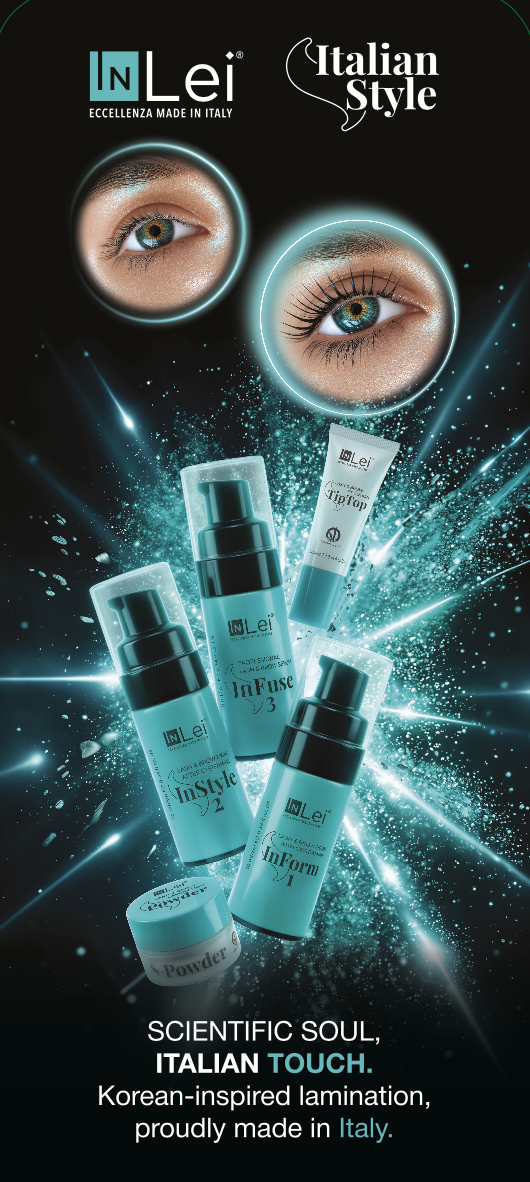
The Next Evolution: InLei® Italian Style Lash Lift
This unwavering commitment to scientific integrity is precisely why InLei® chose not to rush into the trending Cysteamine market. Instead, our research and development team invested over two years of continuous, rigorous clinical testing to solve the stability, retention, and safety challenges inherent to Cysteamine HCL. The result of this extensive research is our upcoming Cysteamine-based product line: the Italian Style Lash Lift. Designed to blend the chemical benefits of Cysteamine with refined, practical application techniques grounded in empirical research, this new system offers artists the most coherent, protective, and reliable method available for Cysteamine-based lamination.
A central highlight of this revolutionary system is the InLei® TipTop (Lash & Brow Tip Lotion). Applied prior to the perming and neutralizing steps, this specialized formula shields the fragile ends of the lashes from chemical stress, completely preventing the kinking and structural degradation traditionally associated with full-length solution placement. Combined with certified batch consistency and clinical safety testing (including Canadian HRIPT and ocular tolerance studies), the Italian Style Lash Lift establishes a new gold standard for Cysteamine treatments. We are thrilled to announce that this entire system is scheduled to officially launch and be available for purchase in the final quarter of 2026 (Q4\ 2026).